01 / Content operations, automated
You've already recorded more than you publish.
I install a machine that turns everything you record into everything you should be publishing — every week, without anyone on your team touching it.
02 / The weekly grind
One clip is not one job. It's eleven.
Everybody bought a tool that does the cutting. Nobody bought the other ten steps — so somebody on your team still does them, by hand, every week, forever.
And the archive just sits there. Hundreds of hours, already paid for, earning nothing.
03 / Your number, not mine
What that grind actually costs you.
Move three sliders. The arithmetic is yours — I'm not the one who decides whether it's worth fixing.
The material stacked up behind this panel is the number you just set.
Hand-work per year
768 hrs
What that costs you
$42,240
Hours back, per year
384 hrs
That's 9.6 working weeks of somebody's year, returned — and the build pays for itself in 22 weeks.
Figured at half the manual time removed — a deliberately conservative floor, not a best case. In practice it lands higher; I'd rather the number on your screen be one that survives contact with your actual week than one that flatters the pitch.
04 / What gets installed
One recording in.
A week of publishing out.
Built on your stack, in your formats, to your brand. Nothing to log into, no seats to buy — when it's done, it's yours.
Everything moving past you is real output from my own channel.
- 01 Ingestyour recording, exactly as filmed
- 02 The cutmoments found, clips born, captions burned
- 03 The gatedefects ejected before anything ships
- 04 Distributionfour platforms, four sets of specs
Your platforms, your specs — the four above are an example, not a limit.
05 / The install
Five parts. You own all of them.
01
The Weekly Machine
Every new recording becomes finished, captioned, platform-ready short-form — cut, cropped, covered, copy drafted, scheduled. It runs whether or not anyone remembers to start it.
02
The Archive Pass
Your back catalogue mined once: the strongest moments pulled, chapters written, transcripts made searchable, the best of it published. The library you already paid for, put to work.
03
The Gate
Automated checks before anything publishes — aspect, loudness, caption timing, safe areas, missing metadata. This is the part almost nobody builds, and it's the reason the machine can run without a person watching it.
04
The Console
One screen: what's in flight, what shipped, where it went, what's late. No more asking three people in a group chat.
05
The Handover
Your existing person runs it — trained, with a written playbook and thirty days of support. No login, no seats, no retainer you can't leave. You own the machine outright.
06 / Same archive, two outcomes
Nothing new gets filmed.
Everything already filmed gets used.
You are flying through my own archive. The empty slots are what a person has time to publish. The filled ones are the same recordings, after the machine.
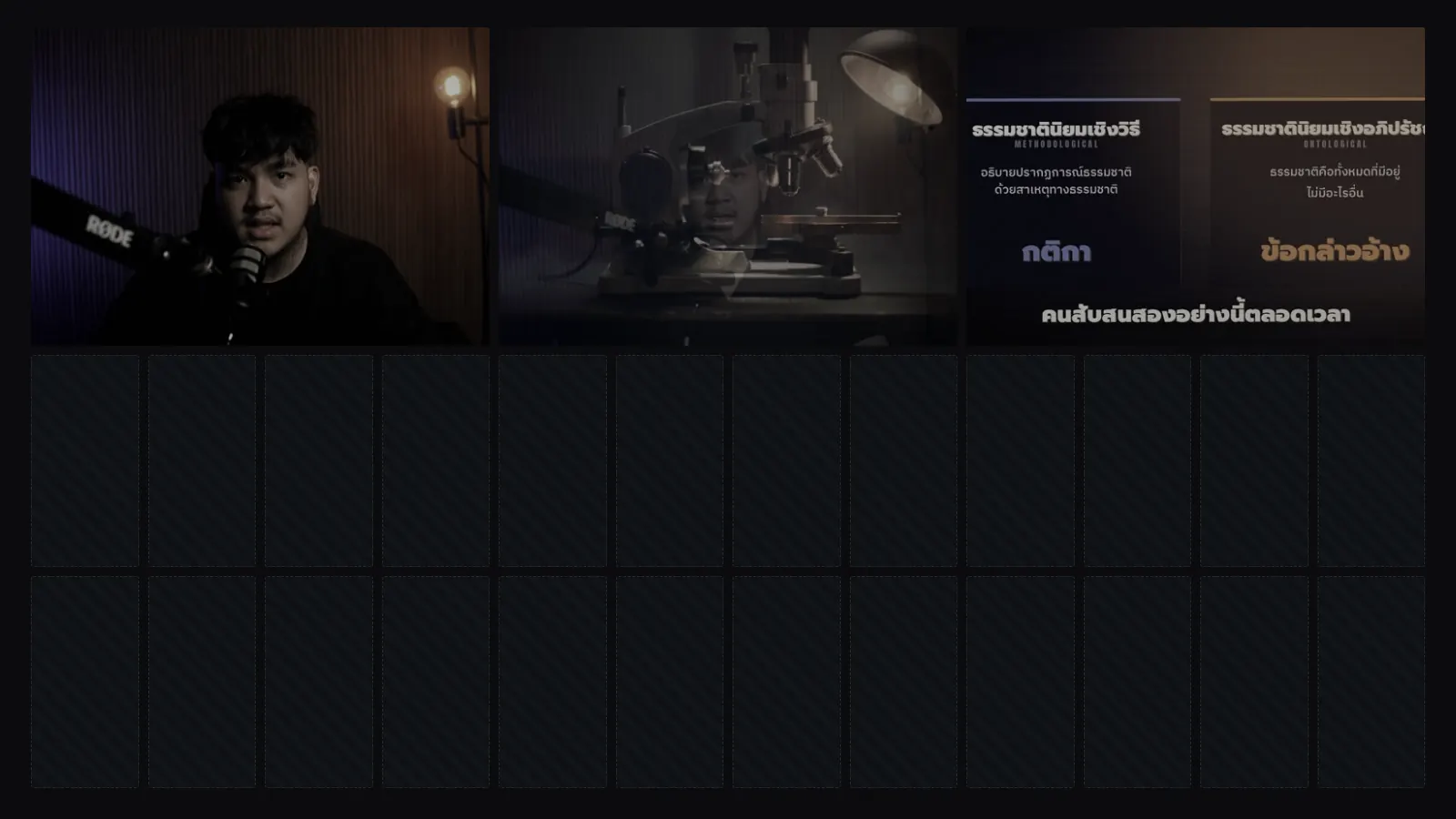
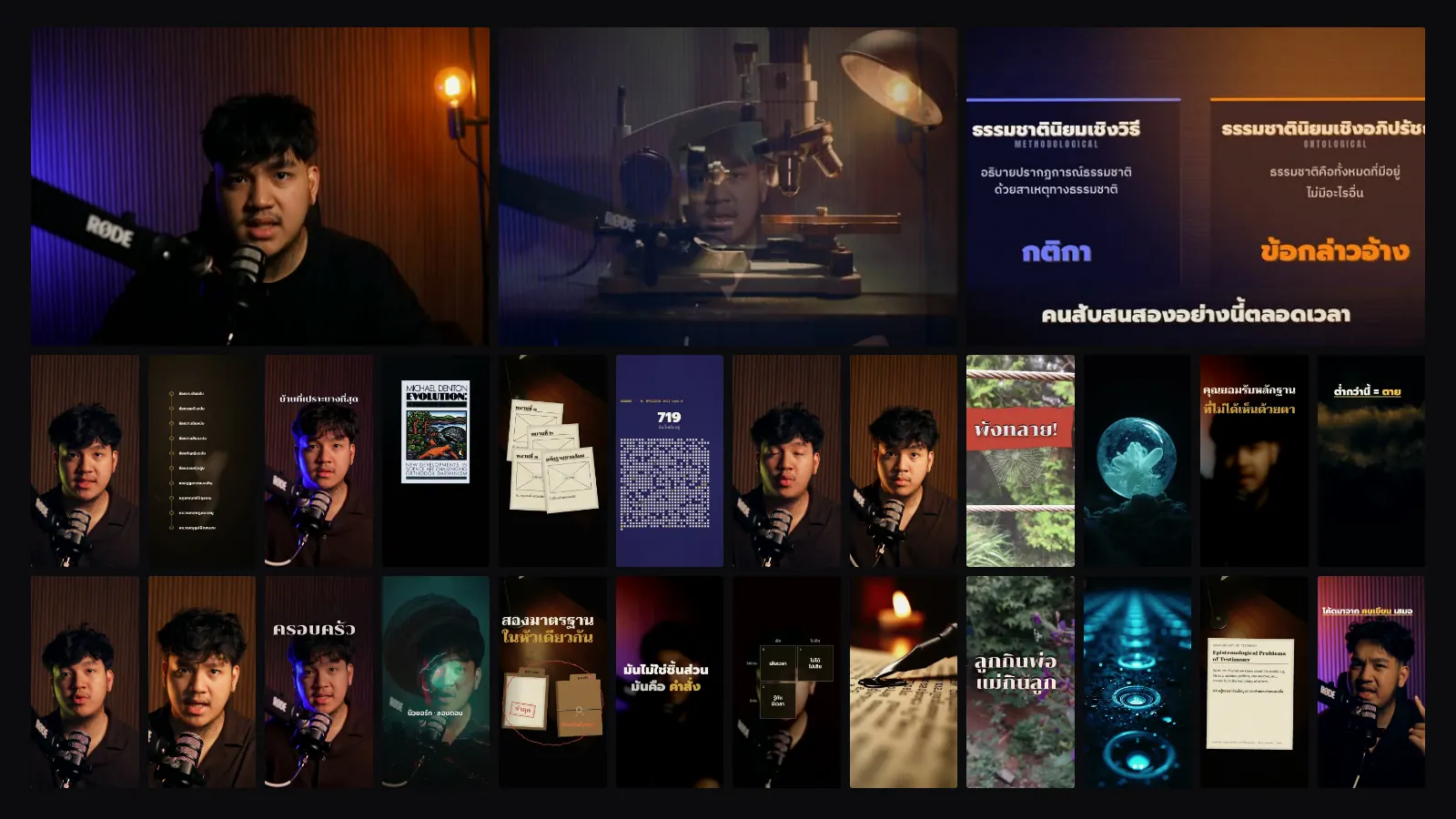
My own archive. Left: what gets published when a person has to do it. Right: the same recordings after the machine — cut, captioned, covered, and pushed to every platform.
07 / Proof
I built this for myself first.
One person, four platforms, two languages, publishing every week — scripted, edited, graded, captioned, covered, published and quality-checked by machine. I'm not a vendor who read about this problem. I ran it at volume and engineered my way out of it.
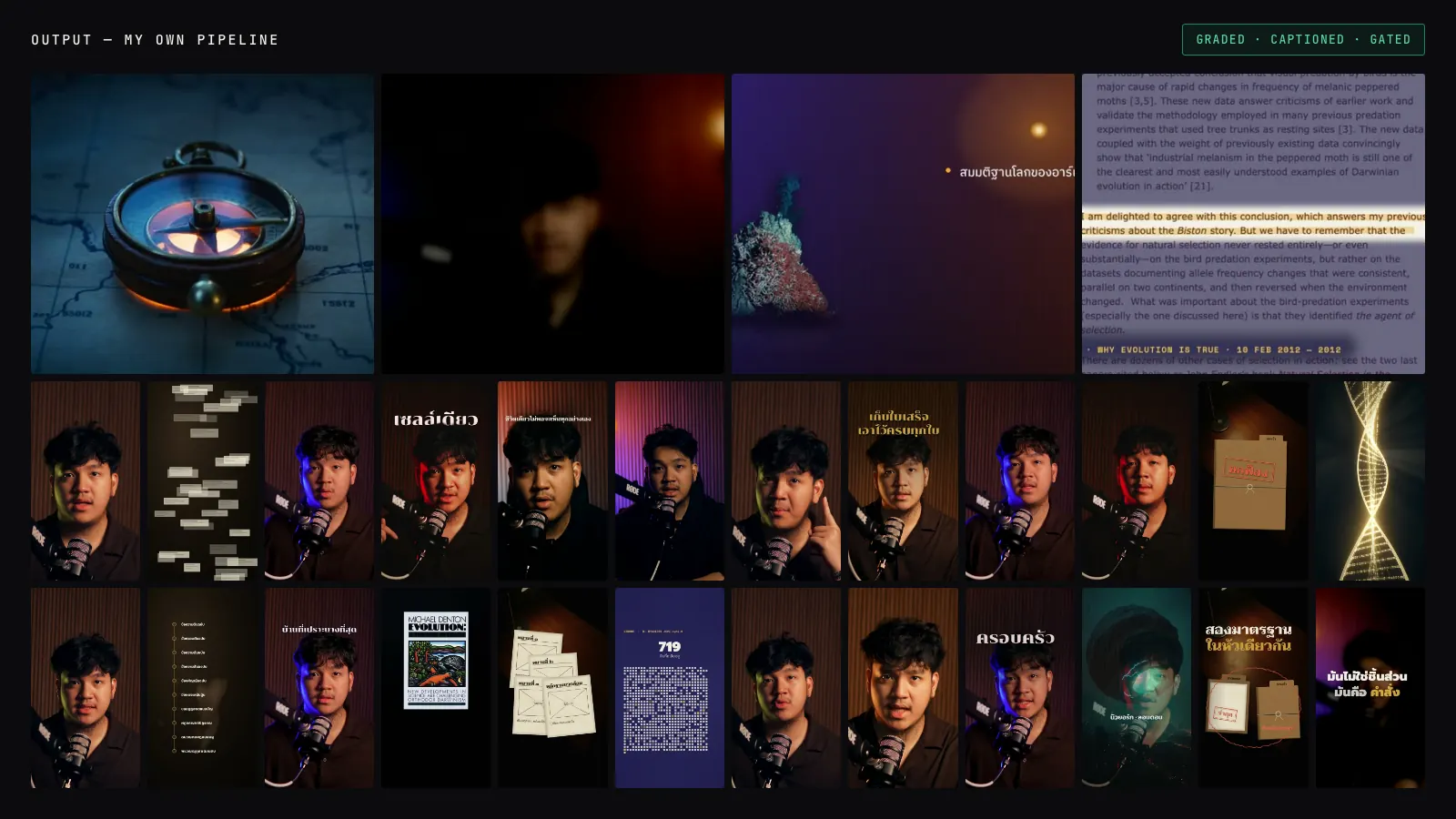
Example board. Mine has to go green before anything publishes.
Your material, not mine
The convincing version of this is your own footage running through it. That is exactly what the twenty minutes is for.
08 / Who you'd be dealing with
One person. Named, and reachable.
Aucas
Builder — Hours Back
Bangkok, Thailand · works with teams in any timezone
I spent years running a publishing operation at volume on my own — scripting, filming, editing, grading, captioning, covering, publishing to four platforms in two languages, every week. I automated it because the alternative was stopping. The machine I sell is the one I run.
You will not be handed to an account manager, because there isn't one. The person on the call is the person who writes the code and the person the guarantee binds.
Straight facts
- New business, old skill. Hours Back is new. The pipeline it installs has been running my own publishing for months.
- No client list yet. I'm not going to invent one. That is exactly why the Proof Run and the guarantee exist — so you never have to take my word for it.
- Two builds a month. Not scarcity theatre — one person can do two properly.
- You own the output. No login, no seats, no platform I control.
09 / How it goes
Three steps. No pitch deck.
Step 01 — 20 minutes
The audit call
I look at what you record and what you actually publish, and tell you the hours sitting on the table. If there aren't enough of them, I'll say so and we're done.
Step 02 — 2 to 4 weeks
The build
On your stack, your formats, your brand. You see it running on your own material before you're asked to trust it.
Step 03 — yours
The handover
Your team runs it, with the playbook and thirty days of me on call. Then it's simply part of how you work.
And from you
Three things. That's the whole ask.
- Twenty minutes on a call, once.
- Access to wherever your recordings already live — and one person who can answer questions for about an hour a week while it's being built.
- One round of notes on the first week of output, so I know what "good" means to you.
If your team ends up doing more than that, I've built it wrong and it's on me to fix.
10 / Price
Published, because you'd ask anyway.
At the numbers you set above, the grind costs you $42,240 every year, again next year, and the year after. Everything below is paid once.
Start here if unsure
Proof Run
$1,500
Two weeks
Paid once, up front
- One show, one month of output
- Run on my machine, on your material
- You keep everything produced
- Credited in full toward the build
Most teams start here
The Build
$9,000
2–4 weeks
Half to start, half on handover
- The Weekly Machine
- The Gate
- The Console
- Handover, playbook, 30 days support
Archive & second language
The Full Install
$15,000
4–6 weeks
Half to start, half on handover
- Everything in The Build
- The Archive Pass over your back catalogue
- A second-language edition of the show
- Handover, playbook, 30 days support
Two builds a month, booked in order. Optional afterwards: $500/month to keep the machine current when platforms change their specs — cancel any time, and it keeps working either way.
11 / The guarantee
What I am on the hook for.
You have thirty days after handover. If you're not happy — for any reason — I refund the build in full.
No conditions, no scorecard, nothing for you to prove. Thirty days is the whole of it — a promise with a stated end is one I can actually keep, which is more than an open-ended one is worth.
I can write it because of the Gate. The machine catches its own defects before handover, so this isn't a bet on luck — it's a bet on something I have already checked.
12 / Fit
Worth being blunt about.
Built for
- Talking-head, interview, lecture, panel, webinar, product and screen-recorded content
- Fifty or more long-form pieces already published
- Somebody on your team doing this by hand right now
- A team that wants to own the machine, not rent a service
Not for
- Music and entertainment
- Alcohol, gambling, interest-based lending
- Adult and dating
- Anyone wanting a monthly editing service — that's not what this is
Not a judgement on anyone. It's just not work I take.
13 / Straight answers
The ones you're already thinking.
Can't we just do this ourselves?
Yes. Everything I use is available to you. What you'd be buying is the months it takes to learn which parts matter — while the weekly work keeps happening anyway. If your team has those months spare, spend them; you'll end up somewhere good.
Is this an agency?
No. One builder, two projects a month. You talk to the person who does the work, which is the whole reason the guarantee can exist.
Do you edit our videos every week?
No — and I'd turn that job down. I build the machine that does it and hand it to you. You own it, run it, and change it without me. I'd rather build the next one than be your editor.
Can we talk to one of your clients?
Not yet — Hours Back is new and I'm not going to hand you a made-up reference list. That is the honest reason the Proof Run exists at $1,500 and the reason the guarantee is written the way it is: so the risk sits with me, not with you, and you never have to take my word for anything.
What happens to our recordings?
They stay where they are. The machine is installed on your storage and your accounts — I work inside your stack, not on a copy of it. I'll sign your NDA before the audit call if you want one, and I don't need a copy of anything to quote the job.
What if you disappear?
It keeps running. You own the machine, the source and the written playbook, and it runs on accounts in your name — there is no server of mine in the path. If I vanished the week after handover, any competent operator could read the playbook and carry on. That is the difference between owning a machine and renting a service.
What does it cost to run after handover?
Whatever your own tooling and compute cost — for most teams that lands in tens of dollars a month, not thousands, and I put the real figure in writing before you buy. The optional $500/month is for keeping up with platform spec changes, not for keeping the machine alive. It runs either way.
How does payment work?
Half to start, half on handover. A Proof Run is paid once up front and comes off the build in full if you go ahead.
Our setup is unusual — will this even work?
Sometimes it won't, and I would much rather we find that out in twenty minutes than in week three. That is the entire purpose of the audit call, and it's why I'll tell you on it if the answer is no.
14 / Next
Twenty minutes, and you'll know.
Bring the channel or the drive. I'll tell you what's recoverable and roughly what it's worth. If the honest answer is "not much", you'll get that answer.
- No deck, no discovery process, no follow-up sequence
- You'll get a number, and what it would take to get it
- If we're not a fit, I'll say so on the call